TRIANGLE, by Katharine Weber
(Farrar Straus Giroux, $23; release date June 13, 2006)

Posted by Anneli Rufus at 8:42 am, Wednesday, May 31, 2006

Unless you’re the type who purposely searches out snippets about disasters, you go your whole life hardly ever hearing about the Triangle Shirtwaist Fire — a 1911 inferno in an overcrowded New York sweatshop which resulted in the deaths of many poor young female workers. And then suddenly, about five years ago, boom: Like the fire itself, retrograde interest in the fire ignites. Crosscutting back and forth from past to present and back, this fictional investigation into the amazing survival of a certain seamstress isn’t the first recent book about the debacle. Just by being a novel, it will dispirit readers who prefer their history pure and unsullied by imaginary characters and invented dialogue — though the survivor’s first-person narrative, told in refreshingly artless language, is the easiest-reading bit. Weber’s real-life grandmother sewed buttonholes at Triangle, albeit two years before the fire, which adds a bit of intriguing backstory. But it takes a true fan of modern literary fiction to warm up to this novel’s main thread in which a contemporary composer is creating an opus based on fractals, Sierpinsky triangles, post-tonal composition, human DNA, the Boulez aleatory creations — and the Triangle Fire.

Grade: C+

FUN HOME, by Alison Bechdel
(Houghton Mifflin, $19.95; release date June 8, 2006)

Posted by Anneli Rufus at 7:43 am, Tuesday, May 30, 2006

She only ever saw her parents kiss once, and that was just a “chaste peck on the cheek.” In this engaging cartoon-as-memoir, Lambda Award-winning comics artist Bechdel searches through layers of incident and artifact for the truth about her father, a style-conscious, aesthetically inclined funeral-home director (hence the book’s title) and English teacher who was also a closeted gay man having secret affiances with students. An author-bio on the back flap describes Bechdel as “a careful archivist of her own life.” This might turn off some potential readers, feeding as it does into today’s tiresome all-about-me movement. Yet the book’s dry wit, sardonic hyperperceptiveness and lithe line drawings pull you in.

Grade: B


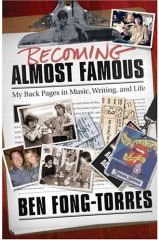
BECOMING ALMOST FAMOUS, by Ben Fong-Torres
(Backbeat Books, $16.95; release date June 3, 2006)

Posted by Anneli Rufus at 11:32 am, Monday, May 29, 2006

This collection of essays from the legendary Rolling Stone journalist — forever immortalized as a character in the 2000 film Almost Famous — spans decades and musical genres, from Janis Joplin to Sheryl Crow, Frank Sinatra to Al Green. Fong-Torres fans might be disappointed to see far too many essays from the ’80s and ’00s, and not as many from Rolling Stone‘s (and Ben’s) halcyon days of the early ’70s. But most intriguing are the essays about Fong-Torres’ own life growing up in Chinatown, and behind-the-scenes details — like separating the truth from the fiction about his on-screen character in Almost Famous.

Grade: B


THE ANZA TRAIL, by Vladimir Guerrero
(Heyday Books, $16.95; release date June 1, 2006)

Posted by Anneli Rufus at 10:37 am, Monday, May 29, 2006

California is so modern — so post-modern — that one hardly thinks of it as a place that needed to be discovered. But once, long ago, the land we now know of as California was unknown to anyone except for a few small bands of Native Americans. The Anza Trail tells a story that for some reason often gets glossed over in the history of America: we hear of pioneers, of Pilgrims, of Lewis and Clark — but how often do we hear the fascinating tale of Juan Bautista de Anza, the Spanish soldier who tromped up and down the state in 1774-5, discovering many of the routes that later became the boulevards and highways of the 20th century? He also coined many of the familiar place names that have survived to this day. While the California coast had already been surveyed by ship, much of the interior was still a mystery by the time de Anza headed off on his journeys. The Anza Trail is the fist accessible book to tell this important story, tracing in detail his excursions, each clearly indicated on a series of very helpful maps. The book’s main drawback is that it gives scant mention to Gaspar de Portola, the first Spanish explorer in California and whose smaller expedition five years earlier laid the groundwork for de Anza. The book would have also greatly benefited from an index, but aside from that it’s a worthy addition to the literature of exploration.

Grade: B+


HOW TO WIN THE WORLD SERIES OF POKER (OR NOT), by Pat Walsh
(Plume, $13; release date May 30, 2006)

Posted by Anneli Rufus at 6:53 am, Thursday, May 25, 2006

To truly “get” this book, it helps to be a poker lover. Or, failing that, to have played a fair amount of poker. Or, failing that, to at least have played some sort of card game, sometime, and to know the rules — because this account by a journalist and all-around regular guy of his decision to go for the high-stakes international gold, the Olympics of poker, does have its share of passages that detail specific games, specific gambits, specific things that specific players do. These poker-specific passages are no doubt rip-roaringly funny to anyone who knows anything about cards, because the other parts of the book — the introspective parts and the parts in which Walsh observes the vagaries of human nature — thrum with such bright authenticity that you know the actual card parts’ve gotta be great too, even if you don’t understand the difference between a “wired pair” and a “walker” and, for that matter, a royal flush. It’s a perfect birthday gift or Father’s Day gift for that loved one who’s always shuffling a deck and stacking up the chips. That’s what those flat things are called, right? Chips?

Grade: B


NOTHING IN THE WORLD, by Roy Kesey
(Bullfight Media, $8; release date May 16, 2006)

Posted by Anneli Rufus at 10:48 pm, Friday, May 19, 2006

Novellas are the violas of the book world: everyone sort of knows what they are but, compared to their bigger and smaller siblings — in this case, novels and short stories — they keep such a low profile that few of us can say we’ve actually read one. Kesey, an American who lives in China but maintains links with the McSweeney’s crowd, began this tale of a Yugoslav soldier thinking it would be a short story. Then it got longer and he thought it might be a novel. But it wasn’t, and he let the story decide how long it wanted to be and when it wanted to end. That’s a brave choice, a matter of trust, and the tale repaid Kesey’s faith by being as silky, sunbaked and lustrous as the sandy beaches its protagonist once strode, dotted with shards of shock and brutality. It’s as streamlined as a beach, too, and reading these 116 pages of prose — not a word out of place and no filler, no fat — makes you realize how padded with fluff most full-length books really are.

Grade: A-


STAGGER LEE, by Derek McCulloch and Shepherd Hendrix
(Image Comics, $17.99; release date May 9, 2006)

Posted by Anneli Rufus at 11:20 pm, Thursday, May 18, 2006

You’ve gotta wonder why one little murder in St. Louis, in 1895 — a guy shooting a guy in a bar — would unleash a flood of folk songs immortalizing the killer, a carriage driver whom some say was a pimp. But it did, and the legend lives on through recordings by everyone from Woody Guthrie to Professor Longhair to Tina Turner to Nick Cave. The latest addition to Stagger Lee (aka Stackolee, Stagolee, and Stag Lee) lore, this hefty graphic novel took writer McCulloch and artist Hendrix seven years to complete. Diving deep inside the heads of even minor characters, it’s so visually and verbally rich as to raise the bar for its genre. This is how good graphic novels can be — and it leaves others looking lazy by comparison.

Grade: A


INTELLIGENT THOUGHT: Science Versus the Intelligent Design Movement, edited by John Brockman
(Vintage, $14; release date May 9, 2006)

Posted by Anneli Rufus at 1:22 pm, Wednesday, May 17, 2006

The “debate” (and even that term is overly kind) between evolution and the repackaged creationism known as “intelligent design” has been played out on local school boards and in the editorial offices of textbook publishers across the country for almost a decade now. (And for over a century before that under different euphemisms as well.) But there is no debate in the scientific community, where 100% of rational scientists acknowledge evolution as the only viable theory to explain the development of life. Yet this certainty in the halls of academe seems to have little effect on the rough-and-tumble playground of public discourse, where religious fundamentalists and decision-makers with agendas have succeeded in reframing the dispute as a battle of competing ideas. Which of course it isn’t — it’s the battle of an idea versus the absence of an idea. Up until now, the scientific world has purposely refrained from even addressing the absurd claims of the “intelligent design” movement, refusing to grant them legitimacy by so doing. But the strategy has backfired: with no one fighting back, the IDers have actually managed to get evolution out of some schools and textbooks.

Frustrated, and mystified by the eternal lure of this seemingly baseless anti-knowledge movement, the scientific world has decided to take the gloves off and punch back. Hard. This volume of sixteen new, previously unpublished essays by leading scientists utterly demolishes any credibility that “intelligent design” ever imagined it had. With a roster of leading lights like Richard Dawkins, Steven Pinker, Lee Smolin, Tim White and a host of other world-class thinkers, Intelligent Thought tackles every aspect of the conflict, from the scientific evidence to the social rationale for trying to promote ignorance. Of course, no one in the ID movement will ever read this book, as they studiously avoid any stimuli that might upset their world view, but it stands alone as an admirable rebuttal of the obfuscatory claims of creationism.

Grade: A


BOOK PRATTLE
Cody’s Bookstore in Berkeley to close

Posted by Anneli Rufus at 2:52 pm, Monday, May 15, 2006

One of the biggest and most iconic bookstores in one of America’s biggest book-towns is soon to be no more. Cody’s Books on Berkeley’s famous Telegraph Avenue will shut down in July. Hands are wringing from coast to coast, and the wringers wail: “But why?” Well, because of money. And how not to make any. Launched in 1956 with a $5,000 loan, Cody’s was a prominent fixture for decades on a student-thronged street that was once the scene of rallies, revolutions, revelations and ribaldry. But something — what? the promise of profits? — lured its current owners to open two more stores. It’s always funny but bittersweet when companies based in capitalism-hating Berkeley, whose downtown was officially off-limits to chain stores until very recently, hear the siren song of cash registers and decide to expand: to become chains, though God forbid that they call themselves that; they’re independent even as they replicate, even as they keep badmouthing Borders and B&N. But even a semiliterate child could have advised them against opening a new Cody’s in downtown San Francisco, within a few blocks of several other established major stores. Talk about a dollar-drain. But that’s not the store destined to vanish, come July. The original Telegraph Avenue store is doomed, because even there, business is way down. This is history happening. Telegraph has transformed from a trendsetters’ haven to a squalid gauntlet that even students tend to avoid. And that’s because Berkeley and its student body have changed, though hardly anyone wants to admit these facts, either. Last month, signs went up announcing that students were staging a lunchtime anti-sweatshop protest on campus — nude. Twenty or thirty years ago, the prospect of shouting, naked guys and gals would have been a major event, attracting news media and crowds. Maybe even ten years ago — but in 2006, passersby barely even cast a glance at the dozen or so protesters, who just stood there forlornly, alone, not even nude but wearing underwear, beating drums. What if you gave a clothing-optional protest and nobody came? Berkeley’s radical mien is in many ways more of a tourist attraction today than bone-deep. These days you need about a 4.3 GPA to gain admittance to UCB. There’s too much studying going on, too many required texts, to allow for much hangin’ out in bookstores anymore. The Beat generation is over, its icons in their graves, their grandchildren in the biochem lab or … um … blogging.


MY BAD, by Paul Slanksy and Arleen Sorkin
(Bloomsbury, $15.95; May 9, 2006)

Posted by Anneli Rufus at 6:56 am, Monday, May 15, 2006

From Dolly Parton (apologizing for claiming that Jews control Hollywood) to David “Son of Sam” Berkowitz (apologizing for killing people), this densely packed grab bag — subtitled “25 years of public apologies and the appalling behavior that inspired them” presents transcripts of mea-culpas from famous figures in many fields alongside capsule reminders of what they did wrong. Having affairs, demanding assassinations, calling disabled folks “cripples” — it’s the sort of collection that too many might all too easily dismiss as a cobbled-together birthday-gift book. But it’s not. Actually it’s a valuable history lesson, reassuring in its lest-we-forgetness, riveting in its revelations. Oh, the humanity. Oh, the blunders. Oh, the lame pleading and doubletalk. Its inclusion of apologizers on both sides of the political spectrum — Hillary Clinton and John Ashcroft, Jerry Falwell and Jesse Jackson, and so on — might have been a clever marketing decision but is also a kind of marvel amid the partisan ballistics that comprise today’s publishing world. For facts alone, this book could be handy for anyone studying American history. Or studying rhetoric. Or having a birthday.

Grade: A-