 Nostalgic Berkeleyans enter Cody’s for the last time.
Notice the “For Lease” sign.Dibs! saw grown men cry during the farewell ceremony today at Cody’s, a big bookstore on Berkeley, California’s famous Telegraph Avenue whose impending closure was lamented recently in the New York Times. (The Times reminisced: “Cody’s, which was founded in 1956, was considered a business innovator for years, adding readings, talkbacks and kaffeeklatschen to the book-buying experience long before Barnes & Noble…. In the 1960’s, the Free Speech Movement leader Mario Savio worked behind the counter at Cody’s, and tear gas was known to waft in occasionally when Vietnam War protesters clashed with police…. Cody’s was a must-see.”) Hundreds arrived on the store’s fiftieth anniversary — which is also the day before it closes — to sip punch and nibble cookies as speakers including
 Maxine Hong Kingston, Mistress of Ceremonies.
emcee Maxine Hong Kingston, owner Andy Ross, founding co-owner Pat Cody, feminist Susan Griffin and historian Leon Litwak mourned aloud. “How poignant and unbelievable we feel,” Kingston began, shakily. Ross hailed Berkeley as “America’s most unique and intellectual community.” (Sorry, Cambridge! Greenwich Village and Austin and Seattle, he seems to be saying that you suck!) “Sales have just plummeted,” Ross explained, noting that while the store pulled in about $10 million a year in the early ‘90s, it was down to $3.5 million these past few years “and going down and down and down.” Also during these past few years, as sales were plummeting, Ross opened not one but two additional Cody’s stores, which aren’t closing — on Berkeley’s chichi Fourth Street and in San Francisco, near several large established book emporia,
 A screen displayed a nostalgic slideshow all afternoon,
including this picture of Andy Ross and Gilda Radner.including fine old indie Stacey’s and a vast Borders. Even a toddler would call this overexpansion a monumental business blunder: arguably greedy, and a truly puzzling move when the book business in general isn’t exactly … well, it’s not whipped iced-coffee drinks. Yet as all of Berkeley buzzes about the Telegraph store’s demise — blaming (as did the Times) chain stores, the Internet, the lack of parking, and the war in Iraq — Dibs! has found that few want to hear Dibs!’s opinion, which is that Cody’s killed Cody’s. And if you’re going to spend fifty years as a radical counterculture hub on a radical counterculture street in a radical counterculture town, championing books about smashing the capitalist state, then should you be surprised when your clientele takes that advice and stops shopping? Speakers at the farewell ceremony lashed
 Former co-owner Pat Cody and current honcho Andy Ross.
out at familiar targets: George W. Bush, technology, the shrinking American mind. And did we mention chain stores? “Does the Internet teach us the meaning of life?” Ross queried. “American cities are becoming one big Walnut Creek, with the ubiquitous Bed, Bath and Beyond,” he mused, dissing a nearby middle-class suburb, then began to sob. Someone read aloud a farewell-to-Cody’s letter from Salman Rushdie, whose The Satanic Verses inspired someone to lob a firebomb through the store’s window in 1989. Ross described “the Rushdie affair” as “Cody’s great historical moment” and “our finest hour” because his store stocked the novel after “the chain stores had already pulled [it] from their shelves.”
 Salman Rushdie hovered over the proceedings, while a
camera flash gave Andy Ross a saintly glow. Reminiscences of that incident — its attendant shock and dread, Ross and his family going into hiding — went on and on although no one mentioned Islam, Muslims or who threw the bomb. But the audience burst into spontaneous, derisive laughter upon hearing the word “FBI.” In his letter, Rushdie wrote: “Thanks to that little firebomb … it became an important store to me.” Ross added, “Nothing sells better than a good banned book.” Kingston, who began visiting Cody’s as a UC Berkeley student in the ’50s, called the store “my haven and home” and said she dearly regretted not having been there on the night when Anaïs Nin did a reading and “was showered with flower petals.” Susan Griffin, author of Pornography and Silence: Culture’s Revenge Against Nature and The Book of the Courtesans: A Catalogue of Their Virtues, spoke darkly of McCarthyism,
 Susan Griffin.
decried Wal-Mart — which “acts as if there is no labor history and no rights for working people” — and lambasted chain stores because “they aren’t community places.” Richard Silberg read a poem he’d written about watching other poets reading at Cody’s. Snatches from the poem include: “Lipsticked, Bopeeped/he declaims/cranking the wings and pulleys of his surrealism … all sex all brainglow/these catwalks/threading the secret city.” Leon Litwak, author of Been in the Storm So Long: The Aftermath of Slavery and Trouble in Mind: Black Southerners in the Age of Jim Crow, urged his listeners to browse at Barnes & Noble, to lounge in “their comfortable chairs” while handling the merchandise, but then to “come back” and buy the books at chairless indie stores. Litwak intoned a rhetorical question and answered it: “What has our country become?
 Chain-store birthday cake.
An empty arsenal.” Behind the curtain that served as the speakers’ backdrop, a large white sheet cake emblazoned with the bookstore’s name awaited the ceremony’s end. It hadn’t been unpacked from its plastic box yet. Umm … did we mention chain stores? As its sticker revealed, the cake came from Safeway.
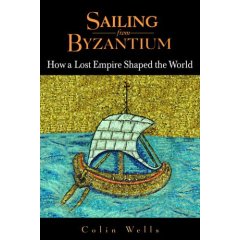 Byzantium is the forgotten empire. Spanning the ancient world and the new, the Byzantine Empire emerged at the fall of Rome and lasted all the way to the Renaissance. Perhaps because it thrived during the misnamed “Dark Ages,” and because it was headquartered where Europe and Asia meet (Byzantium is now called Istanbul), it is seen as being neither here nor there, old nor new, and as such is pretty much ignored in our modern education system. Colin Wells tries his best here to set the record straight, to rehabilitate Byzantium’s reputation, and stake its claim as the actual fulcrum of world events. Sailing from Byzantium is not a straightforward recounting of the empire’s history, but rather is a detailed acknowledgement of its immeasurable influence on three different surrounding worlds: the “West” (i.e. Europe), the Islamic world, and the Slavic world. Wells makes a convincing case that Byzantium’s transmission of ancient Greek classics and philosophy helped inspire the Renaissance, was the main fuel to the golden age of Islamic learning, and brought civilization to Russia and eastern Europe.
 A Jordanian who used free-access computers in an Ohio public library to visit jihadist Web sites and send and receive emails about nuclear bombs and other weapons claims that he isn’t a terrorist — he’s just writing a book. According to
  Not one, not two, but 26 entire libraries have been created and filled with books around Taloqan (depicted at left), the formerly Taliban-held capital of Afghanistan’s war-torn northeastern Takhar province. Within recent memory, rifle fire and exploding bombs were part of the daily retinue in this remote town and its surrounding district where women wear full-body burkas. Even before US forces arrived, the region was a hotbed of battles between the Taliban and the Northern Alliance. In one raid shortly before 9/11, for example, a Northern Alliance contingent seized from their rivals fifty Kalashnikovs, 23 PK machine guns, three ZPU-1 machine guns, two 82 mm recoilless rifles, 19 RPG rocket launchers, two truck-mounted ZSU-23 machine guns, one 82 mm mortar, two pickup trucks and ten wireless communication sets. But now relative peace reigns and it’s reading time, with the help of NGOs and $130,000 from the US Agency for International Development, according to Pakistan’s